As all electrophysiologists know, a good air vibration isolation table is critically important for successful patch clamp experiments. This is because placing a glass electrode having a sub-micron tip onto a living cell requires great stability and no sudden movements from vibrations from the floor of the lab. In these tables, a source of compressed air from either a canister or a building source provides sufficient pounds per square inch to float a steel platter weighing hundreds of pounds on a cushion of air, usually with a servo system to re-adjust the platter if a movement occurs.
We have several of these in the lab, and they are unusually reliable tools that can be a workhorse for many years. However, on occasion they can develop problems over time and for various reasons. In dealing with a troublesome air table that had developed an air leak from its rear leg, I had an epiphany that I hope could be a useful example for students in biophysics to consider. It involves two key mental abilities: critical thinking and problem solving.
Inspection of the back right leg of this particular model, which was obtained from the Technical Manufacturing Corporation (TMC), revealed that the table was bleeding air from what is called the filter trap, a part manufactured by another company but purchased by TMC for its air tables. In our case, air coming from the wall (i.e., from a source in our research building) enters the table via a line that feeds into the filter trap apparatus and then leaves via an exiting line that supplies three valves in the table that support the top. It was clear that the leak was located in the filter trap, which consisted of an aluminum housing with vertical slits surrounding a plastic tube that was rounded at the bottom and that screwed into a brass fitting under the tabletop (Fig. 1).
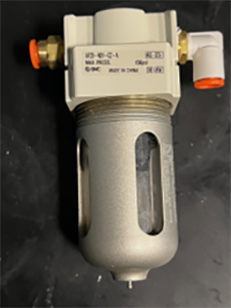
Figure 1: A filter trap.
Because I was unfamiliar with this device, I consulted a technical representative of the TMC company, who explained that this was a filter trap and not a valve; its purpose was to catch contaminants as well as oil or water that may be present in the air supply on which we were relying. Apparently, this is not an unusual occurrence, and these contaminants are potentially destructive to the table. Thus, the idea of the trap is that under pressure the contaminants will be forced through a filter and then down to the bottom of the rounded tube. At the very bottom is a bleed valve, which is much like the type present in car and bicycle tires. The valve here is used to bleed out of the line any liquids that accumulate in the trap. On depressing this valve, I observed no liquid dripping out—the first good sign.
Because the technical representative could not explain the innards of the filter trap in detail (TMC again buys these from a supplier), there was no alternative but to troubleshoot the problem ourselves to identify the cause of the air leak and, hopefully, fix it. Without proper flotation, air tables are useless, so a fix had to be found.
With a colleague (Dennis Larkin), we decided that identifying the site of the leak required disassembly of the filter trap. I reiterate that we were not sure what we were getting into, although we could see that the entire unit screwed into the leg of the table via a brass fitting.
Rotating that fitting and removing the filter trap was illuminating, because it revealed that the outer aluminum housing contained a round and highly discolored filter, a retaining ring that held the filter in place, the plastic round-bottomed tube, and a rubber O-ring that sealed the plastic tube in place onto the brass screw fitting (Fig. 2).
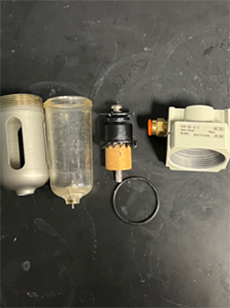
Figure 2: Disassembled filter trap.
Several possibilities presented themselves as the cause of the air leak. Perhaps the O-ring had gone bad, yielding a poor seal? Perhaps the screw fitting was not screwed tightly enough, so that air escaped from the fitting?
However, air was not escaping from the brass screw fitting or from the base of the filter trap where the O-ring resided. In fact, all the air appeared to emanate from the plastic round-bottomed tube, and from there, it escaped out of the aluminum housing surrounding the tube.
Lo and behold, closer examination of the tube showed that there were multiple cracks in the plastic tube that could easily explain the leakage of air, especially because the air was under pressure. This fit the scenario perfectly because the tube was located just within the aluminum outer housing from which most of the air was coming.
Although the representative from TMC pointed out that the entire trap unit could be purchased for a small amount of money ($137.00), he cautioned that the job could be difficult because replacing the entire trap required taking out a set of bolts that were locatedin very tight spaces and nearly inaccessible. However, because we had clearly identified that it was only the plastic tube that was cracked, we reasoned that all we needed to do was replace the plastic tube. Thus, by scavenging a new plastic tube from the new replacement and then replacing the broken tube, we could then screw the whole unit back in place. A straightforward solution!
While I was surfing the web to learn more about pressure valves and filter traps (some valves have an integrated filter trap), I learned that units of this same design are widely used all over the world in applications in which pressure is used. They are present in air compressors used for commercial painting, construction, sandblasting, and many industrial applications. In fact, the units that are used in these various applications look surprisingly like the trap on my TMC table, and they can be very small or exceedingly large, depending on the application. I had no idea!
To hammer home this point, I only had to turn my head to see the valve on the very wall of my laboratory that controlled the pressure of the air supplied to my air table. In place was a much larger valve/filter trap combination that looked exactly like what we were just working on under the table; only in this case, the housing wasn’t made of aluminum but heavy plastic.
We successfully fixed the air leak, but then, on reflection, I realized that this simple example of problem solving was an apt model of the scientific methods that we use every day to solve our research problems. The steps involved are simple enough. First, one has to make careful observations. One also needs to have a concept of how things might work. Sometimes, consultation with outside experts can help a lot, because we are not experts at everything. A little ingenuity comes in handy also; sometimes, some “elbow grease” helps as well
Lastly, solving this little problem in the lab was not only practical and useful, but rewarding and fun. I hope it is of interest.
The author thanks Dennis Larkin for his help and technical savvy in troubleshooting this issue.
—Les Satin