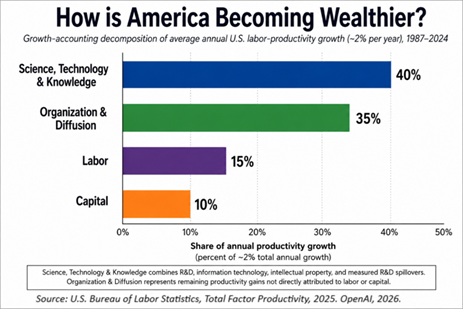
The U.S. government has spent 80 years creating one of the greatest prosperity-generating machines on earth, our federally funded research. Our innovation engine is now under attack. We need to protect it.
As background, the first major U.S. federal research effort was the Manhattan Project, which developed the atomic bomb, which ended World War II in 1945. Policymakers inferred that tax dollars could solve other big national challenges. So federally sponsored basic research grew rapidly, ultimately contributing to the first landing on the moon, world-class defense technologies, medicines, biopharma technologies, computers, solid-state electronics, solar energy, the internet, and AI, and the growth of world-class research universities.
In Aesop's Fables is a story called The Goose that Laid the Golden Eggs. A cottager had a goose that laid a golden egg every day. He supposed that the goose must contain a great lump of gold in its inside, so, hoping to become rich, he killed the goose to extract the gold. To his surprise, there was no gold inside. Never again was he able to benefit from those golden eggs. For the U.S., federally funded basic research has been the goose that lays the golden eggs.
So, why mess with success? Opponents say: (1) That if we ran basic research more like a business, it would be more efficient. And (2) that government intervention in grant decisions could better meet national priorities. Both these arguments profoundly misunderstand two root causes of its success; namely some of the deepest innovation doesn't come from a profit motive, and that governments should set priorities, not meddle in the science. The government is uniquely able to support curiosity-driven deep innovation, accommodate serendipity, and sustain the patience needed for unforeseeable payoffs. By contrast, companies make products to sell, seek markets, pursue relatively quick payoffs, and serve defined stakeholders. Federal funding enables the next big thing rather than the next little thing; trains our next generation innovators; and often leads whole new industries and generational change.
Here are some stories. Consider recombinant DNA, which underpins the biomedical industry. It arguably arose from the 1960s discovery that restriction enzymes could cut DNA, the 1970s development of gene editing, and the rise of biotechnology in companies like Genentech in 1976. Or, clinical MRI, now widely used for brain scans and cancer detection, followed the 1970s discovery that field gradients could generate images from NMR, which itself followed NMR applications to chemistry in the 1950s and 1960s, and the discovery of NMR in the 1940s. Or AlphaFold, the computational tool for protein structure prediction now widely used in drug discovery and recognized with the 2024 Nobel Prize awarded to Baker, Jumper, and Hassabis. It took three generations to develop: from the first protein structure determined in 1958, to the Protein Databank of 260,000 protein structures, to CASP, a community-based computational prediction competition begun in 1994. Similar stories apply to semiconductors, which paid off in the 1960s from the transistor invented in 1947, and to mRNA vaccines, CRISPR, and the sequencing the human genome. Without DARPA and NSF, there would be no internet or GPS. Without NIH, many of today’s drugs would not exist.
Basic science and market-driven research are different ends of a spectrum, depending on whether you seek a known goal or a larger riskier prize. Think about deep innovation. Biophysicists are familiar with Darwinian evolution and computational stochastic optimization where outcomes are not known in advance. To find your pot of gold requires trading off exploitation and exploration. Exploitation is when the goal is known, routes are visible, and you want to maximize benefit relative to cost. That works for making widgets. Exploration, by contrast, is when you don't know where to find the pot of gold, and nearby signposts are insufficient, and where some random sampling is needed to discover potentially superior outcomes. To exploit, take a direct route; to explore, use parallel routes. Nobel laureate Joshua Lederberg put it well: “You rarely find the most important things by deliberately looking for them.” Or, as E. Keinan wrote, “It is a human weakness to assume the future will be an improved version of the past.”
Markets require certainty and immediacy and exploit-dominated research. Conversely, deep innovation entails uncertainty and patience and exploration. For making widgets, you judge success by progress towards cost, benefit, and timeline objectives. For deep innovation, you judge the importance of the questions, the depth of the science, and the landscape of possibilities that may lie ahead. For widgets, you want to minimize cost and minimize duplication. For deep innovation, minimizing cost and duplication can simply foreclose potentially important opportunities.
Of course, serendipity and unpredictability can seem risky and costly. But for some things, the real risk is undershooting. If you want to be sure of getting a garden, plant 100 flowers, not one. I asked ChatGPT to estimate the returns to the U.S. over the past 80 years from federally funded, curiosity-driven research in which the ultimate payoffs were initially unforeseen. It reported 20–40 Nobel Prizes. And it estimated economic returns at an astonishing $30–70 trillion in today’s dollars of economic benefit, or roughly $10–30 of long-term U.S.-wide economic value per federal dollar. It also estimated $100 trillion of social benefit, including health, longevity, reduced disability, environmental improvement, and educational spillovers. While the specific numbers can be debated, the big picture is quite clear: federally funded curiosity-driven research has been one of the most beneficial public investments and economic drivers in U.S. history.
Your Congress folks are home this month, in offices near you. Urge them to advocate for strong budgets for federal science agencies. Urge them to prevent political meddling, and to let scientists make science judgments. Urge them to not be the cottager who killed the goose that lays our golden eggs.
Ken A. Dill, BPS Past President (1998-1999)
Karen G. Fleming, BPS President